
mahmoud abdelaziz
Chapter Three: Glass or Acrylic? – How to Choose the Right Aquarium Material
- ,
- , Marine Guide
🧱 Chapter Three: Glass or Acrylic? – How to Choose the Right Aquarium Material
🔬 A Practical and Scientific Comparison of Available Materials, and How to Choose Based on Usage, Size, and Location
🧭 The Tank Material Isn’t Just a Surface — It’s the Backbone of Your System
When building a marine aquarium, many assume that size or shape is the most important early decision. But in reality, the material your tank is made of (glass or acrylic) is what shapes the long-term stability of the system.
The material affects not only how much pressure your tank can withstand, but also its clarity, resistance to damage, ease of maintenance, thermal performance, and overall longevity.
🪟 Glass: The Classic, Rigid Standard
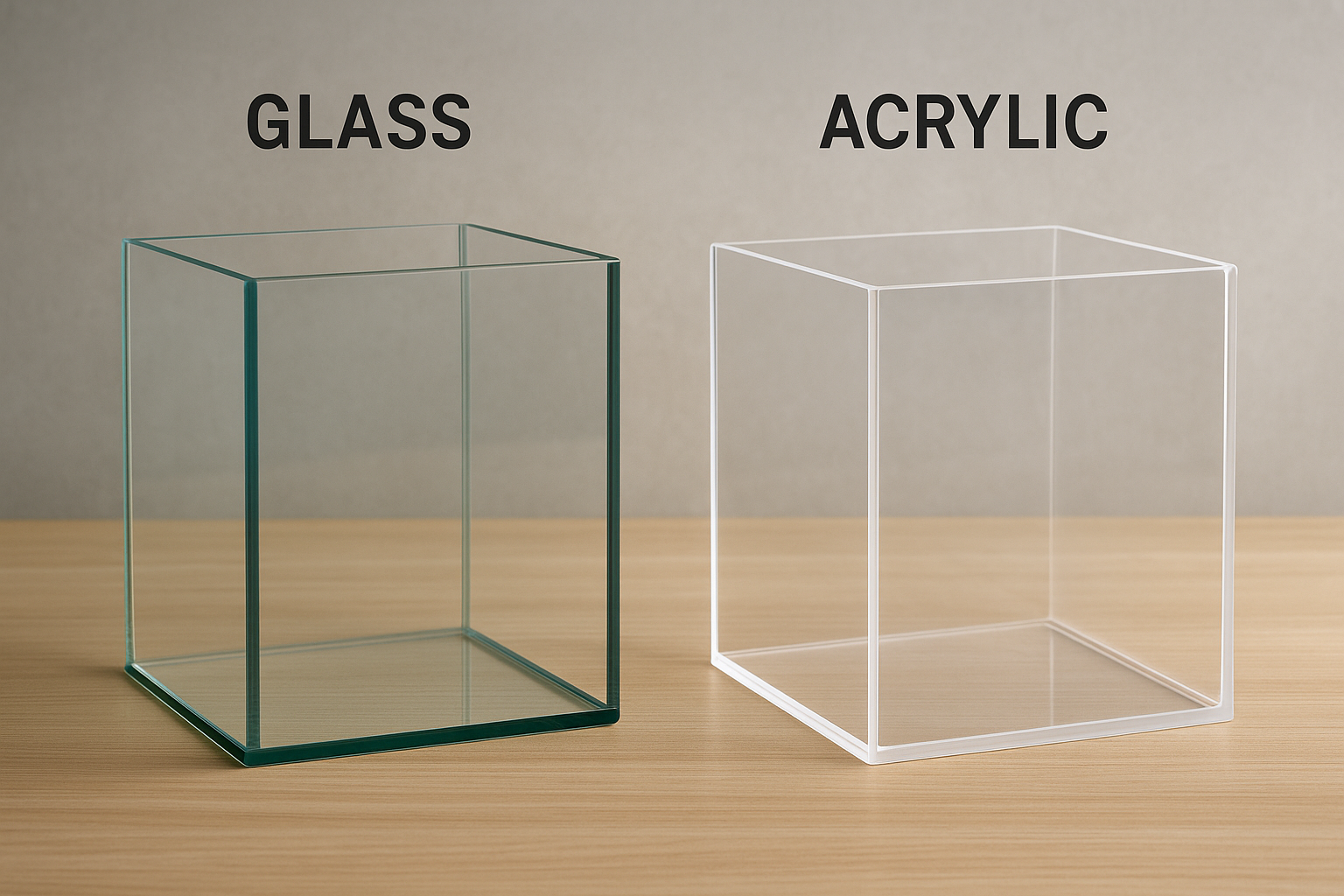
Glass remains the most widely used material in aquariums. It offers a sense of reliability and simplicity. Its clarity is sharp, its surface resists scratches, and it’s the go-to choice for many tank builders.
✅ Advantages:
- Highly scratch-resistant
Daily magnetic cleaning won’t harm it, and it’s safe against sand particles and coral contact. - Crystal-clear visual accuracy
Glass does not create optical distortions (distortion) at viewing angles, offering a realistic image. - UV-stable and long-lasting
Glass doesn’t yellow or degrade under UV light over time, unlike certain types of acrylic. - Lower cost for small to medium tanks
❗ Disadvantages:
- Prone to catastrophic breakage
A hard impact to a corner can cause complete failure. - Heavy weight
Glass tanks may weigh 2–3x more than their acrylic counterparts. - Limited design flexibility
Glass can’t easily be shaped into curved or panoramic designs.
🔍 Common Types of Glass Used in Aquariums
| Type | Properties | Notes |
|---|---|---|
| Float Glass | Standard glass | Most common, with slight green tint along edges |
| Low-Iron (OptiWhite) | Ultra-clear glass | Premium visibility, more expensive |
| Tempered Glass | Heat-strengthened | Safer (shatters into small pieces), but cannot be cut post-manufacture |
🧊 Acrylic: Lightweight Transparency with Design Freedom
Acrylic (PMMA – polymethyl methacrylate) is a synthetic material often mistaken for simple plastic. But in aquarium building, it’s trusted for some of the world’s largest and most advanced systems.
✅ Advantages:
- Up to 50% lighter than glass
Easier to move, position, and support structurally. - Thermoformable
Can be molded into curves, tubes, and panoramic faces. - Exceptional optical clarity
Acrylic transmits up to 92% of visible light, higher than most glass types. - Greater impact resistance
Acrylic bends rather than shatters, making it safer and structurally robust at large scales.
❗ Disadvantages:
- Prone to surface scratching
Requires soft, dedicated cleaning tools. - UV degradation over time
If not UV-resistant, it may yellow or haze in strong lighting. - More expensive for smaller tanks
But becomes cost-effective in large, custom installations.
🔍 Types of Acrylic
| Type | Properties | Notes |
|---|---|---|
| Extruded Acrylic | Cheaper, more flexible, lower clarity | Not recommended for marine tanks |
| Cell-Cast Acrylic | Stronger, clearer, UV-resistant | Industry standard for reef displays and public exhibits |
📏 Choosing Thickness Based on Material and Size
As a general rule:
The larger and taller your tank, the thicker the material must be — and glass requires more thickness than acrylic for the same pressure.
Example:
- 120cm long × 50cm high tank:
- Glass: 10 mm
- Acrylic: 8 mm
- 250cm long × 80cm high tank:
- Glass: 19–22 mm
- Acrylic: 15–18 mm
⚠️ Always refer to professional pressure-tolerance charts before deciding.
🧠 Optical Distortion: The Hidden Factor
Acrylic offers higher overall clarity, but may show minor bending effects (distortion) around corners or curved panels due to its refractive index.
Glass, by contrast, tends to feel more “natural” in perspective, though it may be slightly less bright — especially if not low-iron.
🌡️ Thermal Performance: Heat Matters
- Acrylic insulates heat better — up to twice as effective as glass
This helps stabilize temperature and reduces energy needs for heating or cooling. - Glass loses heat quickly, which may increase power use in large reef systems.
⚙️ How to Decide: The Key Criteria
✔️ Choose Glass If:
- The tank is small to medium
- Budget is tight
- You want better scratch resistance
- You don’t need curved or panoramic designs
- The tank will remain stationary
✔️ Choose Acrylic If:
- The tank is large (500+ liters)
- You want a custom or curved design
- Lightweight handling is important
- You can commit to soft cleaning tools
- Thermal stability and energy efficiency matter to you
🎯 Chapter Summary:
The material isn’t just a shell — it’s a structural and functional foundation of your marine ecosystem.
Glass offers visual precision and scratch resistance, while acrylic brings design freedom, clarity, and thermal advantages.
Know your system’s size, style, and demands… and let that guide you toward the smarter, long-term choice.
Continue reading and move to the next chapter:Aquarium Stands & Filtration Systems – Smart Design Below the Surface  English
  العربية