
mahmoud abdelaziz
Chapter One: Introduction to Marine Aquariums – The Philosophy of a Micro-Ocean
- ,
- , Marine Guide
Chapter One: Introduction to Marine Aquariums – The Philosophy of a Micro-Ocean
🪸 When a Drop of Water Becomes a Living Universe
In the depths of the ocean—where silence reigns, time dissolves, and light dances with darkness—life unfolds in its most astonishing forms.
No human rules apply here; only the laws of nature, chemistry, light, gravity, and chance dictate what survives and thrives.
Can such a world be contained within glass?
What may sound like science fiction has become scientific reality.
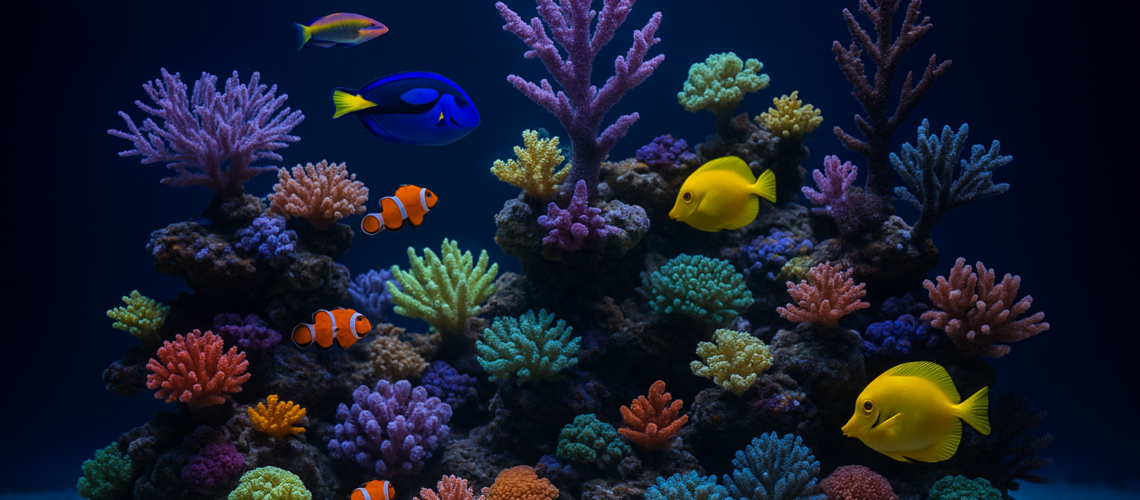
Building a marine aquarium isn’t simply about filling a tank with saltwater, rocks, and fish—it’s the creation of a micro-ecosystem, where complex biological, chemical, and physical processes interact continuously, mirroring the natural world in miniature.
🌍 A Marine Aquarium Is More Than Just a Hobby
To some, a reef tank might seem like an elegant decoration or a calming visual element.
But to dedicated aquarists—and marine scientists before them—it is far more:
- A living laboratory, used to observe microbial behavior, test water chemistry, and explore ecological balance.
- An educational platform, where concepts like biodiversity, food chains, and symbiosis come to life.
- A meditative, even spiritual experience, inviting one to contemplate the vastness of nature through a glass panel.
- A visual art form, where every coral, current, and lighting scheme becomes a brushstroke in a dynamic masterpiece.
🔬 Why Marine Systems Are Different from Freshwater Tanks
Because oceans are more complex than rivers.
Saltwater isn’t just fresh water with salt added. It’s a highly balanced chemical matrix with over 70 elements—some detectable, others only traceable through advanced instrumentation.
Life in saltwater is more diverse, more sensitive, and more specialized. Every coral, fish, sponge, and invertebrate depends on a precise equilibrium of:
- Temperature
- Alkalinity and pH
- Calcium, magnesium, and strontium
- Water currents and spectral light
- Trace elements and nutrient gradients
Even a minor deviation in any of these factors can lead to catastrophic consequences—sometimes within hours.
🧠 The Reef Tank as a Closed Biological Brain
In scientific literature, the marine aquarium is often described as a “semi-artificial closed system.”
This means we are creating an enclosed environment, yet striving in every possible way to replicate the natural balance of the ocean.
And here lies the philosophy:
You’re not just controlling pumps or turning on lights—you’re orchestrating a complex web of interactions:
the spectral quality of light, the positioning and texture of rocks, the colonization of beneficial bacteria, the nutrient flow shaped by algae, and the subtle chemical and behavioral interactions between invertebrates.
All of these elements must coexist in harmony, often with minimal interference from you.
Your role is not to dominate the system, but to guide it gently—to intervene only when necessary, and to allow nature to find its own balance whenever possible.
This is the art of intelligent non-intervention:
learning when to observe, when to act, and when to simply let the ecosystem do what it was designed to do—thrive.
📚 The Purpose of This Series
This series does not aim to give you generic advice or simplified checklists.
Instead, it seeks to build a scientific mindset—a framework of understanding that empowers you to design, manage, and evolve your own reef system with clarity and confidence.
We will start with the fundamentals:
- Choosing the right tank and materials
- Designing a functional base and filtration system
- Seeding your biological cycle with rock, sand, and bacteria
- Introducing livestock in harmony
- Mastering chemistry, lighting, and water movement
- And advancing to AI, automation, and breeding systems
Every chapter adds a foundational brick to your reefkeeping knowledge, backed by modern science and proven experience.
📌 Is This Path for Everyone?
No—not everyone who fills a glass box with water and fish can claim to have a marine aquarium.
A reef tank is not a toy.
It is a responsibility—a microcosm of nature placed in your hands.
But it is also a transformational experience:
- It teaches discipline and patience
- It reconnects you to the rhythms of nature
- It turns every moment of observation into a lesson in biology, chemistry, and philosophy
🧭 This Is the Beginning
If you’ve read this far, you’re not looking for shortcuts.
You’re seeking understanding.
Let this be your starting point.
Join us—step by step—on a journey from first-time aquarist to expert reefkeeper.
Welcome to the world of marine aquariums—
a world small enough to hold in your hands, yet vast enough to contain the ocean itself.
Continue reading and move to the next chapter:Types of Marine Tanks – From Fish Only to Full Reef Systems  English
  العربية