
mahmoud abdelaziz
Chapter Two: Types of Marine Aquariums – From “Fish Only” to Full Reef Systems
- ,
- , Marine Guide
Chapter Two: Types of Marine Aquariums – From “Fish Only” to Full Reef Systems
🐠 How Your Tank Type Shapes Your Entire Journey
🔰 A Philosophical Entry – Do You Choose the Aquarium, or Does It Choose You?
Before you buy a single piece of glass, build a sump, or turn on a light, you must ask one fundamental question:
What am I trying to create?
Do I want an aquarium that showcases marine fish only?
Or a tank that reflects the complexity of coral and invertebrate life?
Or a dynamic balance between both?
Or am I seeking to replicate a specific natural ecosystem in its full detail?
This may sound like a simple question—but it is, in fact, the cornerstone of your entire aquarium journey.
The type of tank you choose doesn’t just determine the species inside—it defines:
- The kind of lighting required
- The filtration architecture
- The amount and type of live or base rock
- The intensity and direction of water movement
- The thermal and chemical balance
- The supporting equipment
- And even the knowledge and mindset required to maintain it
A marine aquarium isn’t just decoration—it is a living system, and every system has its own laws.
📊 Why Starting With the Tank Itself Is a Common Mistake
One of the most frequent mistakes made by beginners is starting from the middle: buying a tank first, and only then wondering what to stock it with.
This often leads to:
- Wasting money on incompatible equipment
- Introducing species that do not coexist peacefully
- Experiencing die-offs due to instability
- Facing a rapid breakdown of the biological balance
The correct approach is to start at the end:
Define your long-term goal, then work your way backward to build a system that will support it.
🐟 Type One: Fish Only (FO) Aquariums
🎯 The Philosophy Behind This Type
This is the most basic form of a saltwater aquarium: colorful marine fish swimming in an artificial or semi-natural setting, without corals or sensitive invertebrates.
Décor often includes dead rock, artificial structures, or decorative items.
✅ Advantages:
- Beginner-Friendly Setup
Requires only basic understanding of water quality and mechanical filtration. No need for advanced lighting, chemical dosing, or microelement management. - Freedom to Keep Aggressive or Exotic Species
You can house species that are incompatible with reef environments, such as:- Lionfish
- Triggerfish
- Moray Eels
- Non-reef-safe Butterflyfish
- Lower Initial Cost
No need to invest in specialized reef lighting, supplements, or controllers. - Creative Freedom in Aesthetics
You’re not limited by the biological needs of corals or live rock—feel free to design your own visual style.
❌ Disadvantages:
- Limited Biodiversity
With fewer biological layers and no corals or live substrates, the ecosystem can be more fragile and reliant on artificial control. - Heavy Dependence on Filtration Systems
The absence of natural nutrient processing requires robust mechanical and chemical filtration to maintain stability. - Difficult to Upgrade Later
Transitioning an FO tank to a reef system usually involves major changes in lighting, water flow, rockwork, and nutrient balance.
👤 Who Is This Type For?
- Complete beginners who want a low-maintenance saltwater setup
- Enthusiasts fascinated by large, aggressive, or rare fish
- Aquarists looking for minimal complexity and equipment
🐚 Type Two: FOWLR – Fish Only With Live Rock
🧬 The First Step Toward a True Biological System
✳️ What Is a FOWLR Aquarium?
The difference between a FO and FOWLR setup may seem minor to the untrained eye, but from a microbiological perspective, the difference is profound.
FOWLR tanks incorporate live rock—not just as decoration, but as entire colonies of beneficial bacteria and microscopic organisms that play a critical role in the nitrogen cycle and biological stability.
These tanks may also contain hardy invertebrates like snails and hermit crabs, without yet entering the complexities of coral keeping.
✅ Advantages:
- Effective Nitrogen Cycle:
The bacteria inhabiting the porous structure of live rock convert ammonia and nitrite into less harmful nitrate—a vital biological function.
With live rock in place, the aquarium begins to develop its own internal “immune system.” - More Stable Ecosystem:
Compared to FO tanks, FOWLR systems offer increased stability and resilience thanks to microbial support in breaking down waste and processing nutrients. - A Natural Aesthetic:
Live rock brings a dynamic, living appearance to the tank, often giving rise to small organisms over time—sponges, copepods, feather dusters…
It’s like the aquarium is reborn every few weeks. - A Stepping Stone to Reef Systems:
FOWLR is the ideal transitional stage for those planning to enter the reef-keeping world. It trains the aquarist in nutrient management and microbial balance.
❌ Disadvantages:
- Higher Initial Cost:
Natural live rock, especially high-quality pieces, can be expensive and requires careful handling and acclimatization. - Risk of Unwanted Hitchhikers:
Some live rock can introduce undesirable guests: predatory worms, invasive anemones, or nuisance algae that may be hard to control later. - Limits Certain Fish Choices:
The presence of microfauna or small invertebrates can make certain aggressive species (e.g., puffers or some triggers) unsuitable.
🧪 Live Rock as a Biological Reactor:
In FOWLR systems, live rock isn’t just a background. It’s the biological core of the tank, where:
- Microscopic chemical reactions take place
- Both nitrifying and denitrifying bacteria live
- Some beneficial organic compounds are produced
- Microhabitats form for essential plankton and copepods
Each rock becomes a living colony of invisible workers, helping your system mirror a natural reef environment.
👤 Who Is FOWLR For?
- Aquarists seeking a natural, visually rich tank without the challenges of coral care and precise dosing.
- Hobbyists who enjoy watching their tank evolve biologically over time.
- Those planning to eventually upgrade to a full reef tank.
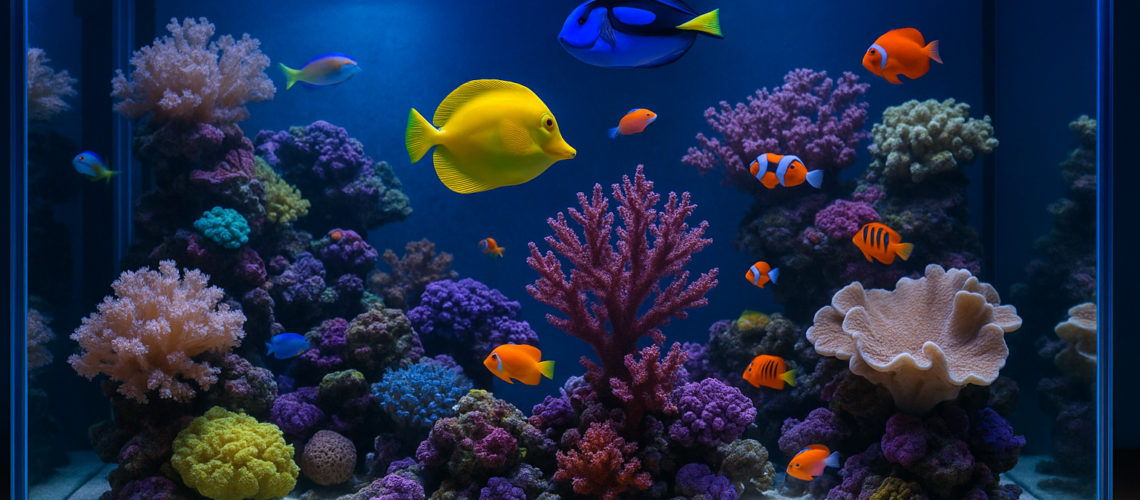
🪸 Type Three: Reef Aquariums
🌊 The Peak of Complexity… and the Heart of Marine Beauty
✳️ Introduction
When we speak of reef aquariums, we’re not simply referring to tanks filled with marine life. We’re talking about a complete miniature ecosystem, where chemistry, physics, lighting, nutrition, and biology interact in a finely tuned balance.
A reef tank is more than a hobby—it’s a living, breathing system, one that demands both scientific understanding and intuitive care.
This category is typically divided into three main levels, based on coral type:
1️⃣ Soft Coral Tanks
🌱 The Gentle Entry into the Reef World
✅ Advantages:
- High Tolerance to Fluctuations
Soft corals like Xenia, Mushrooms, and Leathers are hardy and forgiving of moderate changes in water quality. - Lower Lighting Requirements
These corals can thrive under moderate PAR levels, reducing costs and complexity. - Fast and Easy Propagation
Soft corals often reproduce quickly and naturally, filling the tank with vibrant movement over time. - Graceful Flow Response
Their swaying under current adds dynamic motion and life to the aquarium.
❌ Disadvantages:
- Some species (e.g., Xenia) can overgrow and take over the tank if left unchecked.
- They may release allelopathic chemicals that harm nearby corals under stressful or crowded conditions.
👤 Best For:
- Beginners seeking an accessible introduction to coral keeping
- Hobbyists who want beauty without complexity
- A stepping stone before moving into more demanding coral types
2️⃣ LPS (Large Polyp Stony) Coral Tanks
💎 A Blend of Beauty and Manageable Challenge
✳️ Description:
LPS corals combine the skeletal structure of stony corals with the soft, fleshy polyps of soft corals.
Common species include Hammer, Favia, Trumpet, Candy Cane, and Acanthastrea.
✅ Advantages:
- Striking Color and Texture
These corals display rich color patterns and enhance visual depth under reef lighting. - Distinctive Movement
Certain LPS like Hammer corals have a mesmerizing swaying motion. - Moderate Demands
While they require more stable conditions than soft corals, they’re far more manageable than SPS.
❌ Disadvantages:
- More sensitive to calcium, magnesium, and alkalinity imbalances
- Some species can deploy sweeper tentacles or chemical signals to damage neighboring corals
👤 Best For:
- Intermediate aquarists looking to elevate their reef experience
- Those who want a balance between visual impact and system stability
- Aquariums with decent lighting and a foundational understanding of water chemistry
3️⃣ SPS (Small Polyp Stony) Coral Tanks
🧠 The Ultimate Challenge—Where Precision Meets Art
✳️ Description:
SPS corals like Acropora and Montipora are among the most sensitive marine organisms in the hobby.
Minor changes in:
- Calcium, magnesium, or alkalinity
- Nitrate and phosphate levels
- Lighting spectrum and intensity
- Water flow patterns
- Even fish activity or microelement dosing
…can cause tissue recession, tip burn, or complete coral loss.
✅ Advantages:
- Unmatched Color and Detail
When kept successfully, SPS corals exhibit stunning coloration and intricate growth forms. - Architectural Growth
Branching and plate-forming varieties visually reflect the tank’s conditions and layout. - Long-Term Stability (Once Mature)
Once a balanced environment is achieved, SPS tanks can remain stable for years with precise maintenance.
❌ Disadvantages:
- Extremely sensitive to minor fluctuations
- Requires advanced equipment (dosing pumps, automated testing, constant monitoring)
- Not suitable for beginners
👤 Best For:
- Advanced aquarists seeking the peak of reef-keeping
- Those running fully automated, chemically stable systems
- Reefers who treat coral growth as biological architecture and art
🌍 Type Four: Biotope & Thematic Aquariums
🎯 Your Tank as a Live Scientific Experiment – A Precise Recreation of Natural Habitats
✳️ What Is a Biotope Aquarium?
A biotope tank is a special kind of system built not just around marine life, but around a specific and accurately replicated environment from nature. The goal is to recreate a natural habitat as faithfully as possible, including:
- The water’s chemical composition
- Substrate type and rock layout
- Water flow patterns and intensity
- Lighting type and spectrum
- And even the interrelations between organisms
Examples:
“Red Sea reef tank – 10 meters depth – medium flow – salinity 40 PSU – only species native to the region.”
“Mangrove lagoon tank – muddy sandy substrate – low current – elevated temperature – low-oxygen-tolerant species only.”
✅ Advantages:
- Outstanding Educational Value
Biotope tanks offer deep insight into how marine organisms interact with their exact environment. They’re widely used in museum displays and research facilities. - Authentic Behavioral Observation
Species behave as they would in nature. You’ll notice natural, sometimes rare behaviors that are absent in mixed tanks. - High Artistic and Conceptual Value
These systems represent the peak of craftsmanship. They’re often regarded as living art pieces and “true-to-nature micro-worlds.”
❌ Disadvantages:
- It’s difficult to source exact species from the same habitat.
- Limited species options (must originate from the same ecosystem).
- Requires extensive research and planning.
- Any deviation from the theme can undermine the tank’s integrity.
👤 Best For:
- Detail-oriented aquarists who enjoy research and precision
- Those who prioritize ecological authenticity over color variety
- Educational setups and advanced public displays
🧭 How to Choose the Right Marine Aquarium Type
🧠 It’s Not Just Aesthetic—It’s Strategic
Choosing the right tank type isn’t about following trends. It’s about matching your system to your experience, time, goals, and budget.
Here’s a practical comparison to help guide your decision:
| 🧠 Question | 🐟 Your Answer | ✅ Recommended Tank Types |
|---|---|---|
| What’s your experience level? | Total beginner | Fish Only (FO) or Soft Coral |
| Intermediate | FOWLR or LPS | |
| Advanced | SPS or Biotope | |
| How much time can you dedicate weekly? | < 2 hours | FO or FOWLR |
| 2–4 hours | Soft Reef or LPS | |
| > 5 hours | SPS or Biotope | |
| Do you prefer fish or corals? | Fish-focused | FO |
| Balanced mix | FOWLR or LPS | |
| Coral-dominant | SPS | |
| What’s your starting budget? | Low | FO |
| Medium | FOWLR or Soft Coral | |
| High | LPS, SPS, or Biotope |
🎯 Final Advice:
Don’t try to copy others. Start with what you can manage confidently, and evolve your tank from there.
Marine aquariums reward those who respect the balance of nature, and understand that it’s a system that thrives not on control—but on deep understanding.
Continue reading and move to the next chapter:Glass vs. Acrylic – Choosing the Right Material for Your Aquarium  English
  العربية